Visit Wat Plai Laem, Ko Samui's iconic 18-arm goddess temple. Learn entry fees, best times, and how to combine it with Big Buddha on a single tour.
What Is Wat Plai Laem & Why Visit
Wat Plai Laem sits on the northeast coast of Ko Samui, near Laem Yai and just a few minutes from Chaweng Beach by road. It's a working Buddhist and Chinese-influenced temple complex, built in the early 2000s, and it has become the island's most photographed religious site — more than the older, more traditional temples scattered inland. The reason is simple: the statues here are enormous, colorful, and set against water, which makes for a different kind of visit than a typical Thai wat.
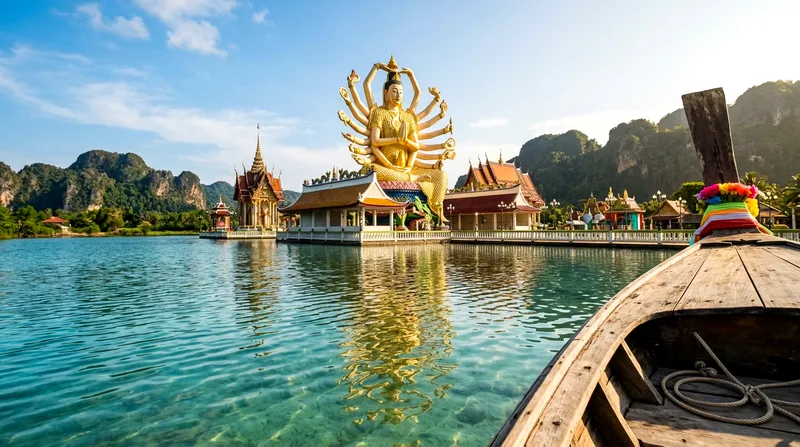
The compound centers on two large figures facing a landscaped lotus pond. One is a fat, laughing Buddha (Phra Sangkajai), and the other — the one everyone comes for — is an 18-armed goddess rising from a lotus base, gilded and visible from well outside the temple grounds. Locals and most tour guides refer to her as Guanyin, the Chinese bodhisattva of mercy, though some literature on site describes her in Thai Buddhist terms. Either way, she's the reason Wat Plai Laem shows up on nearly every "things to do in Ko Samui" list.
The 18-Armed Goddess Statue
The statue stands roughly 18 meters tall on an artificial island in the temple's central pond, connected by a short causeway. Each of the 18 arms holds a different object — a lotus, a vase, a wheel, a sword — symbols associated with compassion and protection in Chinese Buddhist iconography. You can walk the full loop around the pond in about 10 minutes, but most people spend longer than that just finding angles for photos, since the statue catches direct sun differently depending on the hour. Up close, the detailing on the hands and headdress is genuinely intricate — worth the short walk even if you're not religious or particularly interested in temple architecture.
Spiritual Significance and Photo Appeal
For Thai and Chinese-Thai visitors, this is a genuine place of worship — expect to see locals lighting incense, leaving offerings, and praying quietly near the main shrine building, which sits apart from the pond area and houses additional Buddha images. Tourists tend to cluster at the pond and largely skip the shrine interior, which is a mistake if you want context: the shrine has carved wooden doors and ceiling murals that get far less attention than the goddess statue outside. Dress modestly — shoulders and knees covered — since this is an active religious site, not a photo backdrop, even though it functions as one for most visitors.
How to Get There Independently
Wat Plai Laem is one of the easier Samui attractions to reach on your own, which is part of why a guided tour isn't strictly necessary if all you want is this one stop. It sits about 10-15 minutes by road from Chaweng, and roughly 25-30 minutes from Lamai or Nathon, depending on traffic around the ring road. There's no public bus network on Samui in the conventional sense, so your options are self-drive or hired transport.
Rental Car or Motorbike
Renting a scooter runs roughly 150-250 baht a day; a small car is closer to 800-1,200 baht a day, more in high season. Parking at Wat Plai Laem is free and informal — a dirt-and-gravel lot beside the compound that fills up by mid-morning on weekends. If you've never ridden a scooter on Thai roads, be honest with yourself here: the ring road near Big Buddha pier has fast, unpredictable traffic, and Samui's accident statistics involving rental bikes are not reassuring. An international driving permit is technically required for insurance to be valid, and most rental shops won't mention this until something goes wrong.
Taxi and Songthaew Options
Metered taxis barely exist on Samui — almost everything is a fixed-fare negotiation, and from Chaweng you should expect to pay somewhere in the 300-500 baht range one-way, more from Lamai or the airport. Songthaews (shared pickup trucks) run the main ring road and can drop you near the Big Buddha turnoff, from which it's a short walk or tuk-tuk hop to Wat Plai Laem, but they don't run fixed schedules — you flag them down and agree a price, typically 50-100 baht for shorter hops. If you're traveling with young kids or older relatives, a private taxi booked through your hotel is far less hassle than waiting roadside for a songthaew in the heat.
Guided Tours & Multi-Temple Itineraries
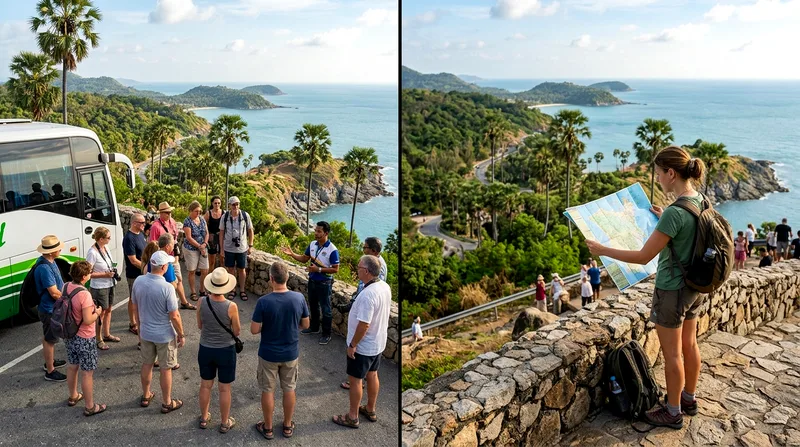
A guided Ko Samui temple tour makes more sense here than at almost any other single attraction on the island, mainly because of geography — Wat Plai Laem, Big Buddha, and the Mummified Monk Temple all sit within a five-minute drive of one another on the northeast tip of the island. Doing all three independently means arranging transport two or three separate times in one day, which is more hassle than it sounds in the heat. A half-day minivan tour typically bundles all three temples plus a viewpoint stop or two, running three to four hours including transfers from south-coast hotels.
Combining Wat Plai Laem With Big Buddha
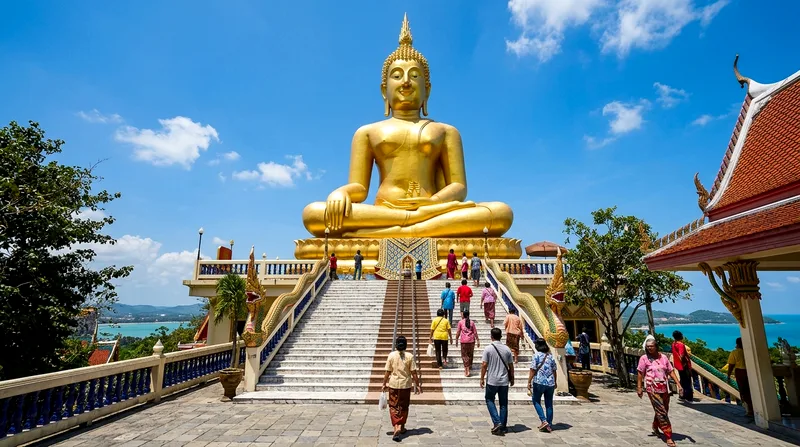
This is the pairing almost every Samui temple tour defaults to, and for good reason. Big Buddha (Wat Phra Yai) is a 12-meter seated golden Buddha on its own small island connected by a causeway — visually completely different from Wat Plai Laem's goddess statue, so you're not seeing the same thing twice. Combined, the two stops take about 90 minutes to two hours including the drive between them. If you only have time for one temple stop on Samui, this pairing is the one I'd recommend over visiting either site alone.
Adding the Mummified Monk Temple
Wat Khunaram, home to the preserved body of a monk who died in meditation decades ago, sits further south near the airport road but is often slotted into the same tour itinerary as a slightly macabre contrast to the other two stops. It's smaller and gets less crowd time — 15-20 minutes is usually enough. Some travelers find it unsettling rather than interesting; if you're traveling with young children, it's worth deciding in advance whether this stop suits your group, since the monk's body is displayed in a glass case and isn't softened for younger visitors.
Entry Fees & Opening Hours
Compared to Phuket's Big Buddha or the entry-ticketed temples around Krabi, Wat Plai Laem is refreshingly low-friction — there's no turnstile, no printed ticket, and no fixed admission price.
Visiting Wat Plai Laem independently costs little beyond transport, while a guided multi-temple tour costs more but solves the logistics of seeing three sites in one trip.
Wat Plai Laem Ko Samui visit options compared: cost, time and access
| Option | Typical Cost | Time Needed | Best For |
|---|---|---|---|
| Self-drive scooter | 150-250 baht/day rental | 45-60 min visit | Independent travelers, budget solo trips |
| Private taxi round-trip | 600-1,000 baht from Chaweng | 60-90 min total | Couples, seniors, short visits |
| Guided half-day temple tour | Mid-range group tour pricing | 3-4 hours | Families, first-timers, multi-temple circuit |
| Songthaew + walking | 100-200 baht total | 90 min+ with waits | Budget solo travelers, flexible schedules |
| Rental car | 800-1,200 baht/day | Flexible, self-paced | Families, groups splitting cost |
Typical figures based on standard Ko Samui transport rates; confirm current prices when booking.
Donation-Based Entry System
Entry is donation-based. You'll find collection boxes near the pond causeway and at the main shrine, and a suggested-donation sign of around 20-40 baht per person in some spots, though nobody checks or enforces it. Parking, similarly, is free. This makes Wat Plai Laem notably cheaper to visit than paid attractions elsewhere on the island, and cheaper than temple complexes in Phuket that now charge set foreign-visitor fees. Bring small baht notes — the boxes aren't set up to make change, and card payment isn't an option anywhere on site.
Daily Access Times
The grounds are generally open daily from around 7 am to 6 pm, though this isn't posted with strict precision anywhere official, and hours can shift slightly around religious holidays. There's no night access and no lighting for an after-dark visit, unlike some temples in Chiang Mai that stay open into the evening. Plan to arrive with at least an hour of daylight left if you're visiting late afternoon, since the shrine interior closes earlier than the outdoor statue area in practice.
Best Time to Visit
Timing your Wat Plai Laem visit matters more than most guides admit — this is a popular stop on every tour operator's circuit, and the pond area gets genuinely crowded by mid-morning.
Seasonal Weather Considerations
Samui's wettest months run roughly October through December, which is the reverse of mainland Thailand's monsoon pattern because of the island's position in the Gulf of Thailand — worth knowing if you're also comparing travel dates for Phuket or Krabi, where the wet season falls earlier. The dry, hot stretch from January to August is more reliable for an outdoor site like this, where most of what you're seeing — the pond, the statue, the causeway — has zero cover. Visiting during a downpour isn't dangerous, just miserable, and photos of a gold statue under gray skies lose most of their appeal.
Crowd Patterns and Photography
Tour buses tend to arrive between 10 am and 1 pm, which is also when the light is harshest and least flattering for photos. Early morning, shortly after opening, gives you softer light, fewer people in your shots, and noticeably cooler temperatures for the walk around the pond. Late afternoon, an hour or two before closing, is the second-best window — golden hour light hits the statue well, though you're racing the 6 pm closing time. If photography is your main reason for coming, skip the midday slot entirely; it's the one time I'd actively avoid.
Nearby Attractions & Add-Ons
Wat Plai Laem's real strength is its location — it anchors a small cluster of attractions that work naturally together, something that's harder to pull off around Lamai or the west-coast temples near Nathon.
Big Buddha Temple Complex
Wat Phra Yai, better known as Big Buddha, is about five minutes from Wat Plai Laem and arguably the better-known of the two among first-time visitors to Ko Samui. The 12-meter statue sits on its own islet, reached by a causeway lined with souvenir stalls and small food vendors — a decent spot to grab fresh coconut or grilled skewers after the temple walk. Climbing the stairs to the base takes about 10 minutes round trip; there's shade on parts of the staircase but not all of it, so this stop suits almost anyone except those with significant mobility limitations.
Mummified Monk Temple and Local Markets
Wat Khunaram, the mummified monk temple, sits a bit further south, closer to the airport side of the island, roughly 20-25 minutes from the Big Buddha/Wat Plai Laem cluster. It pairs well as a third stop if you've booked a half-day tour, but doesn't work as an easy independent add-on given the extra driving. For something lighter after the temple circuit, Chaweng's Central Festival area and the Fisherman's Village night market in Bophut (open evenings, mainly Friday nights) are reasonable follow-ups, and both sit within a 15-20 minute drive of Big Buddha — a natural way to close out the day without backtracking across the island.
Frequently asked questions
What is the 18-armed statue at Wat Plai Laem?
It's a roughly 18-meter gilded statue of a multi-armed goddess, commonly identified with Guanyin, the Chinese bodhisattva of mercy, though temple signage also references Thai Buddhist terminology. Each arm holds a different symbolic object — a lotus, a vase, a sword — representing different forms of protection and compassion. It stands on an artificial island in the temple's central pond, connected to the main grounds by a short causeway.
Can you visit Wat Plai Laem without a tour?
Yes, easily. It's about 10-15 minutes by road from Chaweng Beach, with free parking and no entry ticket required. You can reach it by rental scooter, rental car, or a negotiated taxi fare, and the whole visit takes under an hour. A guided tour only becomes worthwhile if you want to combine it with Big Buddha and the Mummified Monk Temple in one trip.
How much does it cost to enter Wat Plai Laem?
There's no fixed admission fee — entry works on a donation basis, with collection boxes near the main shrine and pond area suggesting around 20-40 baht per person. Nobody enforces this, and parking is also free. Bring small baht notes, since the boxes don't give change and card payment isn't available.
What temples can you visit with Wat Plai Laem?
The most common pairing is Big Buddha (Wat Phra Yai), about five minutes away by road, followed by Wat Khunaram, the Mummified Monk Temple, roughly 20-25 minutes further south. Together these three form Ko Samui's standard half-day temple circuit, usually covered in three to four hours including transfers.
What is the best time to visit Wat Plai Laem?
Early morning, shortly after opening around 7 am, gives the softest light and smallest crowds. Avoid 10 am to 1 pm, when tour groups cluster around the pond and the midday sun flattens photos. The dry season, roughly January through August, is more reliable than the wetter October-to-December stretch for an outdoor site with no real shelter.