Compare Ko Samui family boat and land tours. Learn about seasickness risk, duration, cost, engagement, and crowds to pick the best tour for kids.
Boat Tours vs Land Tours at a Glance
The Ko Samui family boat tour vs land tour decision usually comes down to one question: how will your kids handle a few hours on open water? Boat tours head out to Ang Thong Marine National Park or around nearby islands for snorkeling, kayaking, and beach stops. Land tours stay on solid ground, visiting Big Buddha, waterfalls near Khao Yai-style jungle viewpoints, and viewpoints above Chaweng Beach or Lamai Beach.
Neither option is universally "better." A boat tour delivers the kind of scenery — limestone cliffs, hidden lagoons, clear shallow water — that no land itinerary can match. But it asks more of young passengers: balance, patience, tolerance for engine noise and rocking. A land tour trades that scenery for comfort and control. You can stop the van, let a cranky four-year-old nap, or cut a stop short without disrupting anyone else's day.
I'd lean toward land tours by default for children under 6, and reserve boat tours for families where every child can swim unassisted and has shown they're fine on car ferries or ordinary boat rides. That's a conservative stance, and plenty of families manage perfectly well with younger kids on calm-day boat trips — but when things go wrong on a boat, they go wrong for the whole group, two hours from shore.
For most families, the deciding factors are seasickness risk, child age, and how much open water the itinerary involves.
Ko Samui family boat tour vs land tour: key decision factors compared
| Tour Type | Typical Duration | Seasickness Risk | Best Age Range | Approx. Cost Level | Weather Dependence |
|---|---|---|---|---|---|
| Ang Thong boat tour | 7–8 hours | Moderate to high | 7+ | Mid to higher | High |
| Coastal half-day boat trip | 3–4 hours | Low to moderate | 5+ | Mid | Moderate |
| Full-day land safari | 6–7 hours | None | 3+ | Mid | Low |
| Half-day temple/waterfall tour | 3–4 hours | None | 2+ | Lower | Low |
Typical figures; exact durations, routes, and prices vary by operator and season, so check current itineraries before booking.
What boat tours typically include
A standard Ang Thong Marine National Park day trip runs roughly 7–8 hours door to door, departing by speedboat or larger tour boat from a pier near Nathon or Bophut. Expect two to three stops: a snorkeling spot, a beach landing, sometimes a short hike to a viewpoint overlooking the emerald lake at Koh Mae Ko (steep steps, not stroller-friendly). Lunch is typically served on board or at a beach stop, often a Thai buffet. Life jackets are standard and usually mandatory for the whole trip, which actually helps with child safety and parental peace of mind. Shorter half-day boat trips around Koh Samui's own coastline, without the open-water crossing to Ang Thong, exist too and are gentler for nervous swimmers.
What land tours typically include
Land tours — sometimes sold as "Samui Island Safari" style trips — move by air-conditioned van or open-sided truck between fixed sites: Big Buddha temple, a secret Buddha garden or viewpoint, a waterfall for swimming, sometimes an elephant sanctuary that focuses on observation and feeding rather than rides. Full-day versions run 6–7 hours with four to six stops, giving kids regular breaks to move around. Walking is minimal at most stops — a few hundred meters on uneven ground, occasionally stairs at temples. Because you're never far from a road, bailing out early if a child melts down is genuinely simple, which isn't true once you're on open water.
Seasickness Risk and Physical Comfort
This is the section that should actually drive your decision, more than scenery or price. Boat tours to Ang Thong Marine National Park cross open water for 45 minutes to an hour each way, and that stretch can get choppy — especially from June through October when southwest monsoon swells pick up. A calm sea day feels like a lake. A rough one can turn a boat full of excited kids into a boat full of miserable ones within twenty minutes.
Land tours remove this variable entirely. The worst physical discomfort on a land itinerary is a winding road to a viewpoint, which affects a much smaller percentage of children than boat motion does.
Seasickness considerations for children
Children are more prone to motion sickness than adults, generally peaking between ages 2 and 12, and symptoms often appear faster on boats than in cars because the inner ear gets conflicting signals from the horizon. Practical mitigation: book morning departures, since afternoon seas tend to be choppier after thermal winds build; have kids look at the horizon rather than phones or books; give any anti-nausea medication (many parents use children's dimenhydrinate, following packaging dosage for their child's weight) 30–60 minutes before boarding, not after symptoms start. Sitting mid-boat, lower and more central, reduces motion compared with the bow or upper deck. None of this guarantees a smooth trip — it just shifts the odds.
Physical demands of each tour type
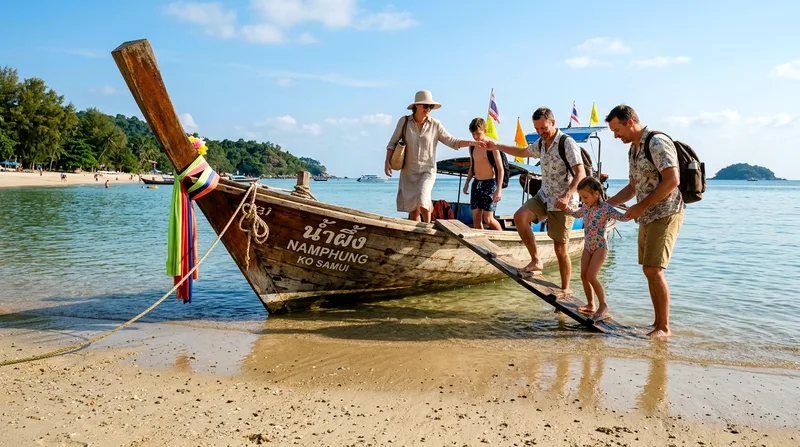
Boat tours demand more balance and core stability than people expect — climbing in and out of longtail boats at beach landings, stepping over gear on deck, snorkeling against mild current. Land tours ask for basic walking stamina and tolerance for heat at outdoor stops like Big Buddha, where the temple complex has open courtyards with limited shade around midday. For a family with a child who has balance issues, sensory sensitivities, or simply dislikes unpredictable movement, land tours are the lower-risk choice, full stop.
Duration, Cost, and Effort Levels
Full-day versions of both tour types run roughly similar hours — 6 to 8 hours including hotel pickup — so duration alone won't decide this for you. The bigger difference is how that time feels for a tired six-year-old: a boat day has long stretches of sitting with nothing to do between snorkel stops, while a land day breaks up naturally with stops every 60–90 minutes.
Time commitment and scheduling
Boat tours typically require an early pickup, often 7:00–7:30am, because morning seas are calmer and the Ang Thong itinerary needs the full day. Missing this window usually means missing the tour, since boats depart on a fixed schedule and won't wait. Land tours have more scheduling flexibility — some operators offer half-day morning or afternoon slots, useful if your family isn't an early-riser household or you want the afternoon free for Chaweng Beach.
Budget comparison and value
Boat tours to Ang Thong generally cost more than land safaris, reflecting fuel, boat maintenance, and national park entry fees. Half-day coastal boat trips or snorkeling-only outings sit closer to land tour pricing. Land tours — especially temple-and-waterfall half-days — tend to be the budget-friendliest option for a family of four, and you're not paying for equipment like snorkel gear or life jackets that young kids may barely use. If you're weighing cost against what Phuket or Krabi charge for similar national park boat trips, Samui's Ang Thong tours are usually comparable, while Koh Phangan and Koh Tao trips (often sold as add-ons from Samui) run a bit cheaper since boat traffic there is heavier and competition keeps prices down. Always compare current prices when booking rather than relying on last season's figures.
Engagement and Crowd Factors
Kids check out fast when bored, and both tour types have dead zones — you just need to know where they are. Boats have long transit stretches with nothing but ocean view; land tours have long van rides between stops on a bigger loop itinerary. Neither is better here in the abstract; it depends on whether your child entertains themselves more easily on water or on wheels.
Child engagement and activity variety
Boat tours offer higher peak engagement — snorkeling over coral in clear shallow water, kayaking around limestone formations, beach time for digging and swimming — but these peaks are separated by passive transit time. Land tours offer steadier, lower-intensity engagement: feeding or observing elephants, splashing in a waterfall pool, climbing temple stairs at Big Buddha for a view over the coast. For kids aged 8+, especially ones who already swim confidently, the boat tour's high points usually win out. For kids 3–7, the land tour's steadier pacing tends to hold attention better and causes fewer meltdowns.
Crowd levels and peak times
Ang Thong boat tours can feel crowded at popular snorkel stops during December–February peak season, when multiple operators converge on the same bays around mid-morning. Land tour stops like Big Buddha also get busy with coach groups, particularly late morning, but the site is large enough that crowding matters less than it does in a confined snorkeling cove. If crowd avoidance matters to your family, ask about smaller-boat or private options for Ang Thong, and aim for the first land tour departure slot of the day.
Which Tour Type Suits Your Family
If your kids are strong swimmers aged 7 or older, none of them gets carsick on ferries, and you're traveling outside the roughest monsoon months, book the boat tour. Ang Thong Marine National Park delivers scenery and water activity that land tours simply can't replicate, and it's a genuinely different day than lounging on Chaweng Beach.
If you've got a toddler, a child with motion sickness history, or you just want a lower-stress day with an easy exit option, book the land tour. You'll still get real cultural and natural sights — Big Buddha, waterfalls, elephant encounters — without betting the day on calm seas.
Couples and solo travelers without kids have more flexibility either way, though the boat tour generally offers better value for adults since the full snorkeling and kayaking experience is wasted on a bored toddler. Senior travelers with knee or balance issues often do better on land tours, since boat boarding and beach landings involve more awkward footing than a paved temple courtyard. European travelers used to ferry crossings in choppy northern seas sometimes underestimate how warm, glassy tropical water can still produce real swell — don't assume your Baltic sea legs transfer directly.
For families splitting the difference, a half-day coastal boat trip (shorter crossing, calmer water, still some snorkeling) is a reasonable middle ground, as is pairing a land tour one day with a short, calm-day boat outing later in the trip once you've gauged how your kids handle water conditions.
Frequently asked questions
Are boat tours in Ko Samui safe for young children?
Reputable operators provide child-sized life jackets and require them worn at all times on deck, which makes boat tours reasonably safe from a safety-equipment standpoint. The bigger risk isn't drowning — it's seasickness and fatigue from heat and motion over a 7–8 hour day. For children under 5, a shorter coastal trip is safer in practice than the full Ang Thong crossing.
How long do typical family tours last in Ko Samui?
Full-day boat and land tours both typically run 6 to 8 hours including hotel pickup and drop-off. Half-day versions of each run roughly 3 to 4 hours. If your children have short attention spans or nap schedules, ask specifically about half-day slots rather than assuming a shorter tour isn't offered.
Which tour type is better for kids prone to motion sickness?
Land tours are the safer choice outright. If you still want the Ang Thong experience, pick a morning departure, choose a larger boat over a small speedboat, give motion sickness medication preemptively, and have your child sit low and central rather than at the bow.
Do land tours or boat tours offer better value for families?
Land tours generally cost less and include fewer per-person equipment fees, making them better value for families with young children who won't use snorkel gear much anyway. Boat tours cost more but deliver activities — snorkeling, kayaking, island-hopping — that justify the price for older kids who'll actually use them.
Can toddlers join Ko Samui family tours?
Most land tour operators accept toddlers, though stroller access is limited at temple stairs and waterfall paths. Boat tour operators often have a minimum age policy, commonly around 2–4 years, partly due to life jacket sizing and partly liability — confirm the specific age policy directly with the operator before booking.